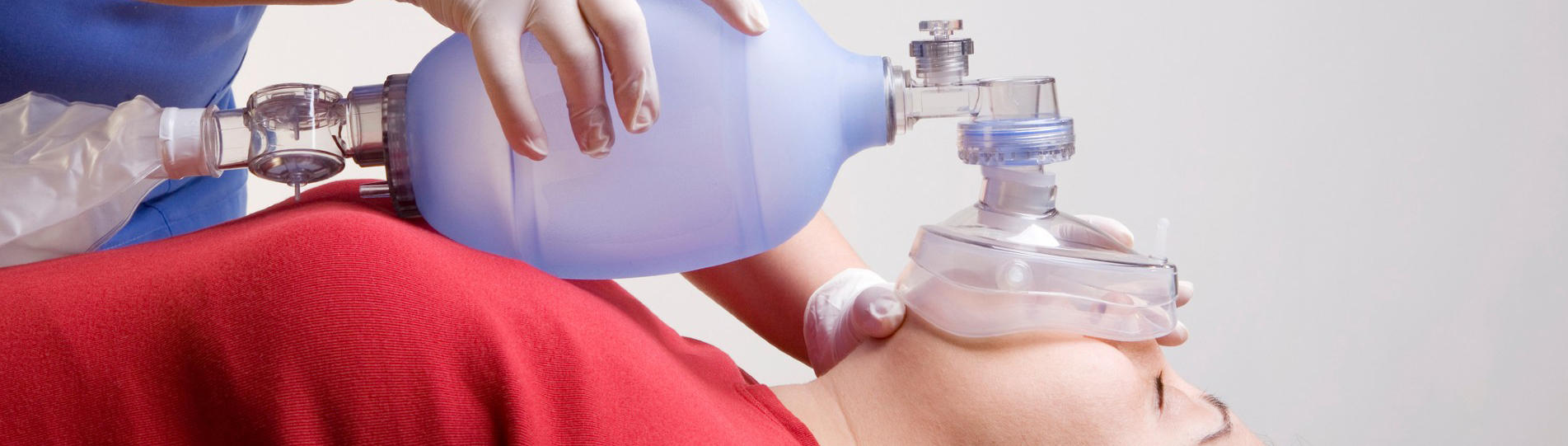

You face a crowded shelf of resuscitators, and three materials compete for your order: PVC, SEBS, and silicone. Each one changes seal quality, durability, and safety in your clinical setting. Each one carries different regulatory demands and a different price. Which material is best for your needs, and why? This buyer's guide answers that question with a clear, side-by-side comparison of all three options. Tianzuo Medical supplies bag valve mask options across every material, so treat this resource as an objective reference, not a pitch. You will see where each material fits, what it costs, and how to verify compliance before you commit.
A bag valve mask is a hand-squeezed manual resuscitator. You deliver positive pressure ventilation by compressing the self-inflating bag while holding a tight mask seal. Material choice drives three outcomes: how well the mask seals against the face, how long the device survives repeated use, and how safely it performs during resuscitation.
Every BVM combines several materials in one device. The bag is a silicone or SEBS bag. The mask is a silicone or PVC mask. The valve body is a PC or silicone valve body. The one-way non-rebreathing valve and the reservoir bag each bring their own material demands. Evaluate each component, not just the bag. A soft, transparent mask supports a visual seal check. A rigid valve housing protects the non-rebreathing valve. Each material earns its place.
Your clinical setting sets the priority. An emergency department with unpredictable volume may favor single-use devices. A long-term care program with reprocessing capacity may favor reusable ones. Transport teams weigh packed weight and shelf life. Training centers weigh cost per student.
Consider the full self-inflating manual ventilation device, not the bag alone. A clear valve housing helps you watch for obstruction during manual resuscitation. A pressure relief valve protects the patient when you squeeze hard. Match these features to your protocols, your staff training, and your budget. No single material wins everywhere. The right choice depends on how you use the device.
Three polymers dominate the market, and each brings distinct properties to a bag valve mask. Medical-grade PVC is a rigid-to-flexible plastic. Manufacturers use it across the manual resuscitator: the bag, the reservoir bag, the mask, and the oxygen tube. A safety valve releases excess pressure when you squeeze too hard. PVC delivers dependable performance at a low unit price.
SEBS is a thermoplastic elastomer. It feels softer than PVC and stays clear. A SEBS Ambu bag offers an eco-friendly disposable option. The clear valve housing gives you a better view of the mask during ventilation. Silicone, by contrast, is a thermoset elastomer. Reusable masks commonly use liquid silicone rubber, which is soft, highly transparent, and FDA-grade. A Silicone BVM Resuscitator withstands repeated reprocessing without losing its seal.
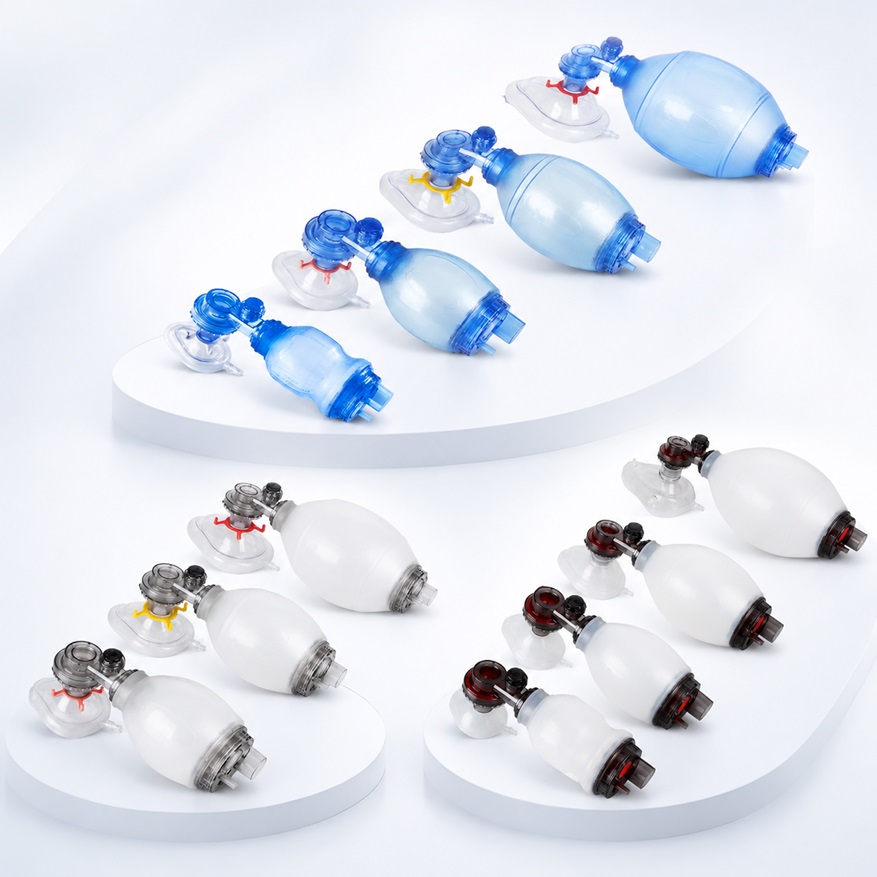
Material maps closely to service life. A single-use bag valve mask typically uses PVC or SEBS. You open it, ventilate one patient, and discard it. A reusable bag valve mask usually uses silicone, which tolerates cleaning and sterilization cycles. Both single-use and reusable versions appear in most hospital formularies, so you likely need both.
The self-inflating bag defines the device category, yet the mask and valve materials decide the seal and the safety margin. Map your procurement to your reprocessing capacity. Sites without sterilization equipment should standardize on disposable PVC or SEBS units. Sites with a central sterile department can justify the higher upfront cost of silicone.
Medical-grade PVC gives you a dependable device at the lowest unit price of the three materials. You can stock every crash cart, ambulance, and triage bay without straining the budget. A PVC Bag Valve-Mask Resuscitator (BVMR) covers the full assembly: the self-inflating bag, the reservoir bag, the mask, and the oxygen tube. One material family serves the whole device, which simplifies your ordering and your staff training.
The material also holds its shape well. A bag made of PVC resists collapsing during storage and delivers a consistent squeeze. The integrated safety valve releases excess pressure when you compress too hard, which protects the patient during manual ventilation. Clear or translucent grades let you watch for condensation and obstruction. For high-volume, single-use programs, this combination of low cost and predictable performance is hard to beat.
PVC is a rigid-to-flexible plastic, not an elastomer. The bag feels stiffer in the hand than SEBS or silicone, and the mask seals with less conformability on irregular face shapes. You may need to spend more time positioning the mask to achieve a tight seal. Staff feedback on hand fatigue during prolonged resuscitation is worth collecting before you standardize.
Reprocessing is the bigger constraint. A PVC bag valve mask is designed for single-patient use. The material does not tolerate repeated cleaning and sterilization cycles the way silicone does. Plan your procurement around disposal volume and waste handling. If your facility runs a reusable program, PVC will not fit that model. Treat PVC as a disposable workhorse, and it performs reliably within that role.
SEBS gives you a middle path between economy and feel. This thermoplastic elastomer feels softer in the hand than PVC, so the bag compresses with less effort during prolonged ventilation. The material stays clear, which helps you watch for condensation, secretions, or obstruction inside the bag. A clear valve housing adds another advantage: you can see the valve action and confirm the mask position during manual resuscitation.
A SEBS Ambu Bag also serves single-use programs well. You ventilate one patient, then discard the device, so cross-contamination risk stays low. The material is an eco-friendly disposable option for facilities that want to reduce the environmental footprint of their consumables. Ordering stays simple, because one SEBS bag valve mask covers the bag, the mask, and the valve housing in a single sterile pack.
SEBS is a disposable material. It does not tolerate repeated cleaning and sterilization cycles the way silicone does, so a reusable program cannot standardize on it. Plan your disposal volume and waste handling before you commit to a full SEBS rollout.
The material also costs more per unit than PVC. Budget-sensitive, high-volume sites may find the premium hard to justify when PVC delivers adequate performance. SEBS also offers less conformability at the mask edge than soft silicone on irregular face shapes. Check the seal quality with your staff before you standardize. Finally, confirm that the reservoir bag and valve body in your chosen SEBS resuscitator meet your protocol requirements, because component materials vary between suppliers.
Silicone gives you the longest service life of the three materials. A reusable bag valve mask built from silicone tolerates repeated cleaning and sterilization cycles without losing its shape or seal. The material stays soft and pliable across many reprocessing rounds, so the bag compresses smoothly on the hundredth use much like it did on the first. You recover your upfront investment over time through fewer replacement orders.
The mask edge shows silicone at its best. Liquid silicone rubber conforms to irregular face shapes and holds a tight seal with less positioning effort. The material is highly transparent, which supports a quick visual check during ventilation. A Silicone BVM Resuscitator also resists hardening and cracking better than disposable polymers. Facilities with a central sterile department can standardize on autoclavable silicone and build a dependable reusable program around it.
Silicone carries the highest unit price of the three materials. A single silicone device can cost several times more than a disposable PVC or SEBS unit, so your budget must absorb a larger initial outlay. That premium only pays back when your reprocessing volume justifies it. Low-volume sites may never recover the difference.
Reprocessing also demands infrastructure. You need validated cleaning and sterilization procedures, trained staff, and tracking to confirm each cycle. Without that capacity, silicone's durability advantage goes unused. The material is heavier than disposable alternatives, which matters for transport kits and stockpiled emergency bags. Weigh these factors against your program's realistic cycle counts before you commit.
Durability separates the three materials most sharply. A Silicone BVM Resuscitator holds its shape and seal across many cleaning and sterilization cycles. The elastomer stays soft and pliable, so the bag compresses smoothly on repeated use. PVC and SEBS serve one patient and then leave the workflow, which makes long-term durability a non-issue for disposable programs. Compare realistic cycle counts against your central sterile throughput before you budget for a reusable fleet.
Flexibility shapes the seal. The reusable elastomer conforms to irregular face shapes with less positioning effort. SEBS feels softer in the hand than PVC, so the bag compresses with less effort during prolonged ventilation. PVC holds its shape well in storage, yet the stiffer bag demands more hand strength and more careful mask placement. Check seal quality with your staff on real patients before you standardize a bag valve mask across a department.
Chemical tolerance follows the same pattern. The thermoset elastomer resists hardening and cracking better than the disposable polymers, which is why reusable programs standardize on it. PVC and SEBS tolerate the disinfectants used in single-use settings, yet neither material suits repeated sterilization cycles. Ask each supplier for cleaning validation data before you commit.
Temperature tolerance matters for storage and transport. All three materials perform within normal clinical storage conditions. The reusable elastomer holds its properties across a wider range, which supports autoclave reprocessing. Disposable PVC and SEBS units need dry, temperate storage. Confirm the supplier's stated storage range before you stockpile devices in vehicles or unheated warehouses.
The one-way non-rebreathing valve deserves separate attention. Its housing is rigid plastic or elastomer, and a clear housing lets you watch valve action during ventilation. A sticking valve defeats the best bag material, so verify valve performance alongside bag performance. Test the valve on a sample unit before you place a bulk order.
Your patient volume and turnover speed decide the disposable question first. An emergency department that treats a steady stream of undifferentiated cases rarely has time to chase reprocessing paperwork between resuscitations. A single-use bag valve mask removes that step entirely. You pull a sterile unit from the crash cart, ventilate one patient, and discard it. The PVC Bag Valve-Mask Resuscitator (BVMR) and the SEBS Ambu Bag both fit this workflow, and both keep your restocking simple.
High-volume training centers face the same math. Every student needs a device, and every device touches a face. Disposable units eliminate cross-contamination concerns between students and remove the cleaning bottleneck from your schedule. Stock your ambulances and triage bays with disposable devices, and you never discover a contaminated unit at the moment you need it.
A reusable bag valve mask only pays back when your facility can clean and sterilize it reliably. You need validated procedures, trained technicians, and cycle tracking. The Silicone BVM Resuscitator supports this model because the elastomer tolerates repeated reprocessing without losing its seal. Reusable autoclavable versions suit hospitals with a central sterile department that already runs a dependable turnaround.
Sites without that infrastructure should think twice. A reusable bag valve mask demands documented cycles, and a missed step erodes the safety margin. Weigh your realistic throughput against your sterile processing capacity before you commit to a reusable fleet. Disposable PVC and SEBS units ask nothing of your reprocessing team, which makes them the safer default for sites with limited sterilization capacity.
Compliance status decides whether your device can enter the market at all. In the United States, a bag valve mask typically reaches the market through the FDA 510(k) clearance pathway as a Class II device. Ask for the clearance letter and confirm the device description matches the unit you plan to order. A clearance for one configuration does not automatically cover a different bag size or reservoir option.
Quality management matters just as much. Look for ISO 13485 certification, the standard for medical device quality systems. For manual resuscitators, ISO 10651-4 sets performance and safety requirements, so a supplier's test reports should reference it by name. If you sell into the European Union, REACH governs chemical substances. Request a declaration confirming the device contains no Substances of Very High Concern above the regulatory threshold. These documents belong in your procurement file before the first purchase order.
Verify the supplier, not just the paperwork. A certificate PDF proves little on its own. Confirm the certificate number and scope directly with the issuing body, and check that the scope covers the exact product family you intend to buy.
Use this checklist for each candidate supplier, including Tianzuo Medical:
Request samples and inspect the labeling, the valve housing clarity, and the pressure relief valve before you sign a supply agreement. Document every response. A supplier who answers these requests promptly and completely demonstrates the quality discipline your resuscitation program depends on.
Your purchase order starts with unit price, and the three materials sort into a clear order. The PVC Bag Valve-Mask Resuscitator (BVMR) carries the lowest unit price of the three. You can stock every crash cart and ambulance without straining the budget. The SEBS Ambu Bag sits in the middle. It costs more per unit than PVC, and you pay that premium for a softer feel and a clearer valve housing. The Silicone BVM Resuscitator sits at the top. A single silicone unit can cost several times more than a disposable PVC or SEBS device.
Compare quotes on identical configurations. Bag size, reservoir volume, mask size, and valve type all move the price. Ask each supplier to quote the full assembly, not the bag alone. A low bag price means little when the mask and valve add cost later.
Unit price tells only part of the story. Total cost of ownership adds reprocessing, replacement, and disposal to the calculation. A reusable silicone program needs validated cleaning procedures, trained technicians, and cycle tracking. Those costs stay fixed whether you process ten devices or a hundred. High cycle counts spread them thin. Low volume leaves them stranded on every unit.
Disposable programs invert the math. The PVC Bag Valve-Mask Resuscitator (BVMR) and the SEBS Ambu Bag ask nothing of your sterile processing team. You pay per patient instead. Disposal volume and waste handling become your recurring cost, and you replace stock steadily rather than in large batches.
Track your realistic annual cycle count before you choose. Divide the silicone premium by your yearly reprocessing volume, and you see the break-even point in plain terms. Sites with steady throughput recover the premium. Sites with low volume rarely do. Weigh total value across the device's life, not the sticker price on the first order.
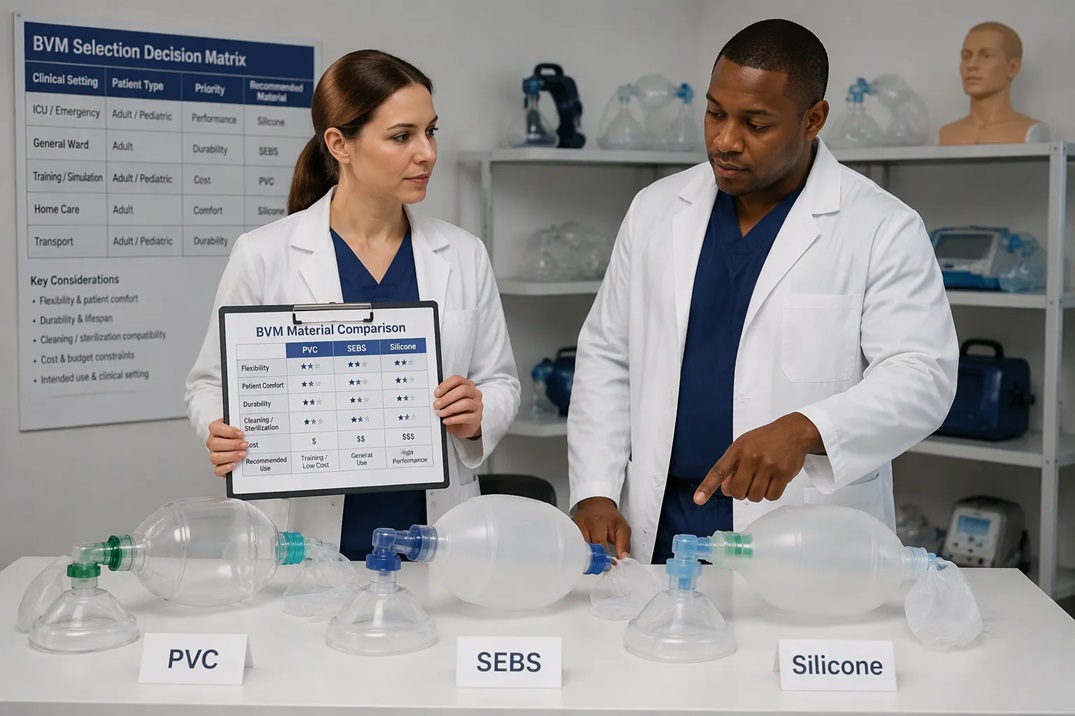
The table below condenses the comparison into five criteria. Ratings reflect the properties described earlier in this buyer's guide, not a ranking of quality. Every material meets its intended role.
|
Criterion |
PVC |
SEBS |
Silicone |
|---|---|---|---|
|
Durability |
Holds shape in storage; single-patient service life |
Holds shape in storage; single-patient service life |
Withstands repeated cleaning and sterilization cycles |
|
Flexibility |
Stiffer bag; mask conforms less to irregular faces |
Softer than PVC; moderate mask conformability |
Softest; conforms tightly to irregular faces |
|
Reusability |
Disposable only |
Disposable only |
Reusable and autoclavable |
|
Compliance |
FDA 510(k), ISO 13485, ISO 10651-4, REACH achievable |
Same pathways achievable |
Same pathways achievable |
|
Cost |
Lowest unit price |
Middle unit price |
Highest unit price; pays back at high cycle counts |
Read across the rows, then weigh them against your own operation. Start with reusability, because that row splits the field in two. A facility without validated sterilization capacity should stop at the disposable columns. The PVC Bag Valve-Mask Resuscitator (BVMR) and the SEBS Ambu Bag both fit that constraint, and the cost row then favors PVC for pure budget pressure.
Move to flexibility when staff report seal difficulties. The SEBS Ambu Bag compresses with less hand effort than PVC, and the Silicone BVM Resuscitator conforms best on irregular face shapes. Training centers and transport teams often weight this row heavily.
The compliance row behaves differently from the others. It shows what each material can achieve, not what a given supplier has documented. A certificate on file proves nothing until you verify its scope against the exact device you plan to order. Treat this row as a checklist item for every candidate, whatever the material.
Finally, run the cost row against your annual cycle count. Divide the silicone premium by your yearly reprocessing volume, and the break-even point appears in plain terms. High-volume sterile processing recovers the premium. Low volume rarely does. Use this matrix as a working tool, revisit it when your protocols change, and request samples before you commit.
Scenario drives the decision more than any spec sheet. A crash cart in a busy emergency department and a sterile processing queue in a long-term care hospital demand different bag valve mask configurations. Map your setting to the material before you compare quotes, and revisit the mapping when your patient volume or reprocessing capacity changes.
Emergency and high-volume settings reward speed and simplicity. You pull a device, ventilate one patient, and discard it. The PVC Bag Valve-Mask Resuscitator (BVMR) fits this pattern at the lowest unit price, so you can stock every bay and ambulance without budget strain. A low unit price also lets you place a unit in every triage bay and supply closet. Its integrated safety valve releases excess pressure during manual resuscitation, and the familiar feel supports consistent bag valve mask technique across rotating staff.
The SEBS Ambu Bag suits emergency teams that want a softer squeeze and a clearer view. Its clear valve housing lets you watch the one-way non-rebreathing valve during positive pressure ventilation. Cost-sensitive sites that still want that visibility often choose SEBS over PVC for single-use deployment. Both materials keep restocking simple, because one sterile pack covers the whole device.
Pediatric coverage matters too. Stock a pediatric and infant bag valve mask set alongside your basic adult bag valve mask, and confirm each size carries the same valve design. Training centers benefit from disposable units most, because every student touches a face and cleaning becomes a bottleneck. Ambulance crews also favor disposable units for packed weight and shelf life.
Volume shapes the choice further. A department that treats many patients per shift cannot wait on reprocessing, so disposable stock keeps the workflow moving. Track your monthly device consumption and set par levels accordingly.
Reusable programs reward durability. A hospital with validated sterilization capacity can standardize on the Silicone BVM Resuscitator and recover its premium across many cycles. The mask conforms tightly to irregular faces, and the elastomer holds its seal after repeated reprocessing. The material also resists hardening and cracking across those cycles. Build your reusable bag valve mask fleet around that material when your annual cycle count is steady and your sterile department runs a dependable turnaround.
Contrast this with a single-use bag valve mask program. Disposable PVC and SEBS units ask nothing of your sterile processing team, yet they generate steady replacement orders. Neither model wins everywhere. A transport team may prefer disposable units for packed weight, while a teaching hospital may prefer the reusable option for its reprocessing throughput.
Run the numbers before you commit. Divide the premium by your yearly reprocessing volume, and the break-even point appears in plain terms. High throughput recovers the premium; low volume rarely does.
Whatever you choose, inspect the complete bag valve mask kit on arrival. Check the valve action, the reservoir connection, and the labeling. Request samples of each candidate unit and test the seal with your staff before you commit. Each material fits a different need, and your scenario points to the right one. Document the decision and review it each year.
No single material wins every procurement decision. PVC, SEBS, and silicone each fit a distinct mix of clinical setting, regulatory pathway, and budget. Use the decision matrix and the scenario guide as working tools, then test samples with your staff before you commit.
Contact Tianzuo Medical for material-specific specifications and samples. This buyer's guide closes on one principle: judge total value across the device's life, not the sticker price on the first order. A reusable bag valve mask rewards steady reprocessing volume, and a disposable bag valve mask rewards speed. Either way, your resuscitation program deserves a choice you can defend.
Start with your reprocessing capacity. Choose silicone when you run validated sterilization cycles and steady volume. Choose PVC or SEBS when you need single-use devices. Then weigh seal quality and budget. No material wins every scenario, so match the device to your clinical setting first.
Count your annual cycles. A reusable bag valve mask pays back its premium at high reprocessing volume. Low volume rarely recovers the difference. Sites without a central sterile department should standardize on disposable units. Document the decision and review it each year.
Confirm the ISO 13485 scope covers resuscitators. Check the FDA 510(k) number in the public database. Request material grades, REACH declarations, and sterilization validation data in writing. Inspect samples for valve action and labeling. A prompt, complete response signals quality discipline.
The Silicone BVM Resuscitator holds its seal across many cleaning cycles. You replace devices less often, so the higher unit price spreads across years of service. That math only works when your sterile processing throughput stays steady. Low-volume sites should compare total cost carefully.
Not directly. Bag softness affects hand fatigue during prolonged ventilation. Mask conformability drives the seal. Silicone conforms best on irregular faces, SEBS sits in the middle, and PVC demands more careful positioning. Test seal quality with your staff on real patients before you standardize.

 Поддержка сети IPv6


 русский
 English
 فارسی
 français
 Deutsch
 italiano
 español
 português
 العربية
 Türkçe